

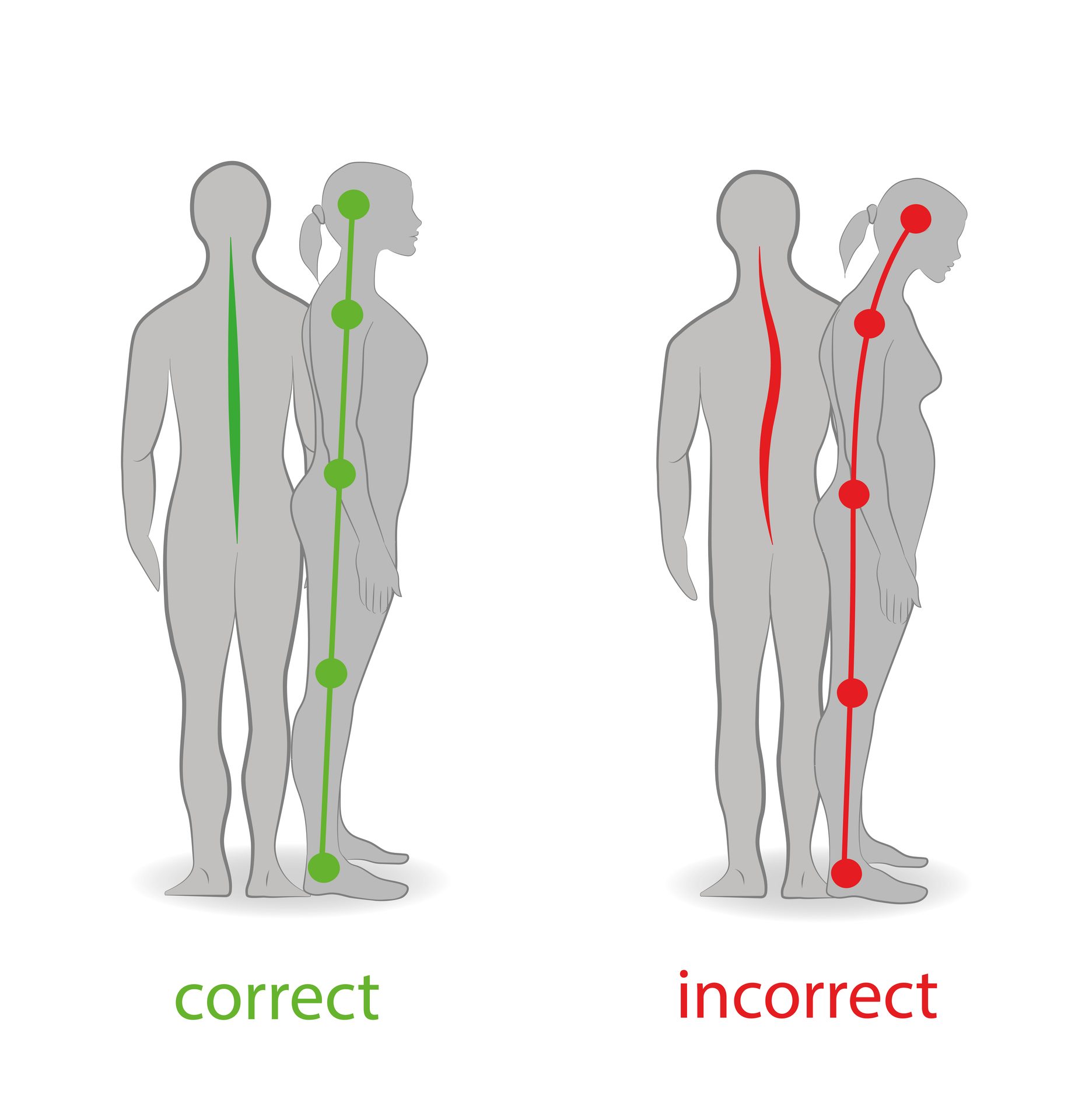
Most people think of good posture as standing up straight and pulling the shoulders back. That is part of it. The deeper definition is simpler: your head sits centered over your body, and your weight is distributed evenly side to side and front to back. When that happens, the muscles, joints, and ligaments do the least amount of work to keep you upright. When it does not, something else has to compensate.
In NUCCA care we measure this with the vertical axis. The vertical axis is an imaginary line that runs straight down through the center of your body. A properly aligned spine and skull should sit on or very near that line. When the Atlas – the top bone in the neck – shifts even a few millimeters, the head moves off that line. The rest of the body then shifts to keep the eyes level and the head upright. One shoulder rises. One hip drops. Weight shifts onto one leg. The spine curves to compensate. None of this is dramatic at first. Over months and years it becomes the way you stand, sit, and move.
That compensation is not free. Muscles on one side stay tight. Joints on the other side take more load. Ligaments that were meant to share the work now carry it unevenly. The nervous system, which relies on clear signals from the upper neck to know where the head is in space, gets mixed information. People often describe the result as fatigue, stiffness, headaches, dizziness, or a sense that they are never quite comfortable, even when scans show nothing structurally wrong.
NUCCA is a specialized chiropractic technique that focuses on the Atlas and its relationship to the skull and the rest of the neck. Unlike general chiropractic, it does not twist or pop the spine. We take specific X-rays, measure how far the head has moved off the vertical axis, and apply a light, calculated correction. The goal is to center the head so the body no longer has to compensate. When the head is centered, the shoulders can level, the hips can level, and the weight can spread more evenly. The nervous system gets clearer information. The muscles that were guarding can ease. The joints that were overloaded get a chance to recover.
Symptom relief is welcome. Many people notice less neck tightness, fewer headaches, or better balance after the correction holds. But the primary aim is not to chase a particular symptom. The aim is to remove the mechanical interference at the top of the neck so the body can operate closer to the way it was designed. A clear vertical axis is not a guarantee of perfect health. It is a better starting point. When the head is centered and the spine is not locked in compensation, the body has a clearer path to heal, recover from daily stress, and stay upright with less effort.
If you have been told your scans are normal and you still feel off – tight, unbalanced, or simply tired of holding yourself together – the upper neck is worth measuring. Good posture is not a pose you hold for a photograph. It is the result of a head that sits where it belongs.
Dr. Charlie Ross, DC
NUCCA Upper Cervical Care
4345 Roosevelt Way NE, Seattle, WA
(206) 504-2225
About the Author